The right laser treatment depends on the tissue being treated, the diagnosis and the result you need—not simply on whether a clinic offers laser dentistry. By matching your symptoms with the laser type, conventional alternatives, anaesthesia requirements and clinical limitations, you can arrive at a more useful treatment decision in Dwarka.
Key takeaways
- Match the laser to the tissue: gums, teeth, frenum and whitening need different plans.
- Ask which wavelength, tissue and treatment goal your dentist recommends.
- Confirm whether laser treatment replaces cutting, drilling or conventional periodontal care.
- Choose conventional treatment when it offers better access, control or long-term value.
Start with the tissue: a plain-language map of dental laser procedures
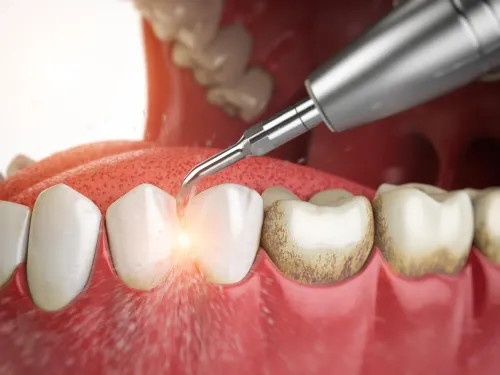
Match the procedure to the tissue being treated, not to the word “laser.” Dental laser procedure types differ by wavelength: erbium lasers can work on enamel, dentin and some soft tissue, while diode, Nd:YAG and CO₂ lasers are used mainly for soft tissue. One device cannot perform every laser dental treatment option.
- Gum bleeding or deep pockets: periodontal assessment comes first. A laser may support selected gum treatment, but it does not replace probing, radiographs, scaling and root planing, or removal of plaque and calculus with ultrasonic or hand instruments.
- Excess gum tissue: gingival contouring or gingivectomy reshapes soft tissue.
- A tight frenum: frenectomy releases the band under the lip or tongue.
- A mouth ulcer: a soft-tissue laser may reduce discomfort in selected cases, but it does not diagnose the cause.
- Tooth decay: a hard-tissue laser may remove selected decay or condition enamel and dentin; the tooth may still need a filling, crown or root-canal treatment.
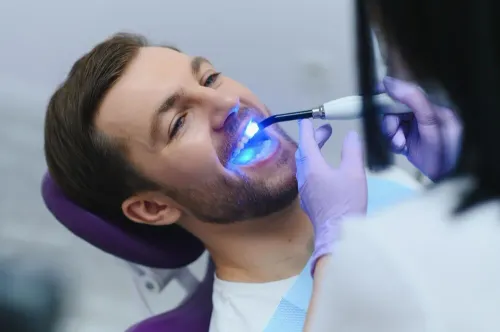
- Whitening: laser-assisted whitening targets the bleaching process, not gum or tooth structure.
- A lump or persistent lesion: laser removal does not eliminate the need for diagnosis or histopathology.
| Procedure | Tissue target | Key limit |
|---|---|---|
| Soft-tissue laser | Gums, frenum, selected lesions | Not a substitute for periodontal cleaning or biopsy |
| Hard-tissue laser | Enamel, dentin, selected decay | Not suitable for every cavity or restoration |
| Laser-assisted whitening | Bleaching treatment | Does not repair decay or change every type of discoloration |
Gum bleeding, excess tissue or a tight frenum need different plans
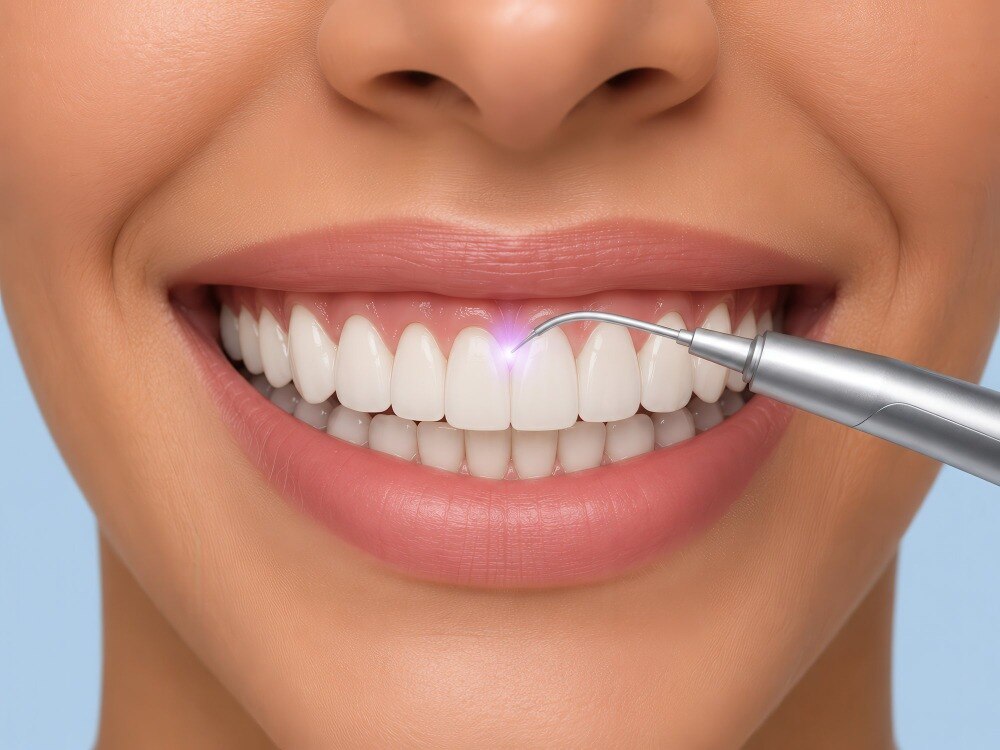
Laser gum treatment is suitable only when the cause of the gum problem matches a soft-tissue laser procedure. Searching for laser gum treatment dwarka does not determine the answer: the dentist needs periodontal probing and, when indicated, dental X-rays to identify infection, bone loss, trapped plaque or a structural issue.
Use this checklist to understand the likely decision:
- Bleeding gums or deep pockets: scaling and root planing mechanically removes plaque and calculus from tooth surfaces. A laser does not replace that cleaning; it may be an add-on in selected periodontal cases, not a guaranteed superior treatment.
- Excess gum covering part of a tooth: gingival contouring or gingivectomy can remove and reshape the tissue. The dentist must check whether inflammation, medication or gum disease caused the overgrowth, or it may return.
- A tight frenum pulling the lip or affecting tooth spacing: a laser frenectomy can release the band of tissue. Treatment is appropriate only when the frenum causes a functional or orthodontic problem.
- A lump, persistent ulcer or unusual patch: do not treat it as cosmetic excess. The tissue may require biopsy and histopathology before or after removal.
- Pain or inflammation without tissue removal: low-level laser therapy is different from cutting laser surgery, and its benefit depends on the diagnosis and protocol.
Less bleeding or no sutures can be useful, but they do not guarantee faster healing or a better long-term result.
Cavities, sensitivity and whitening are separate laser decisions
A laser is useful only when its wavelength matches the tissue and the diagnosis. The same symptom can point to different care, so choosing among laser dental treatment options starts with examination, and sometimes X-rays or periodontal measurements—not with the device available.
| Problem | When a laser may help | What it cannot replace |
|---|---|---|
| Cavity | A hard-tissue laser can prepare selected areas and remove some decay. | It cannot treat every depth or location; you may still need a rotary instrument, filling, crown or root-canal treatment. |
| Sensitivity | A suitable laser protocol may reduce dentin sensitivity by altering exposed tubules after the cause is identified. | It does not fix decay, a cracked tooth, gum recession or an incorrect bite. |
| Whitening | Laser-assisted whitening may shorten an in-office appointment in a specific bleaching protocol. | Bleaching chemistry, concentration, exposure time and sensitivity determine much of the result; activation is not essential for every treatment and does not make whitening permanent. |
Ask which laser, wavelength, tissue target and evidence apply to your procedure. A diode laser used on gum tissue is not equivalent to an erbium laser used on tooth structure, and a frenectomy protocol does not prove effectiveness for periodontal disease.
These dental laser procedure types should be judged separately from conventional alternatives such as desensitising treatment, rotary preparation or professional bleaching light.
What happens at a laser consultation, and what should you ask?
A dentist determines whether laser treatment is safe and appropriate by confirming the diagnosis, identifying the target tissue, and matching it to a suitable wavelength, device and setting. A bleeding gum, cavity, tight frenum and mouth ulcer are not interchangeable problems.
The examination may include periodontal probing, photographs, bite checks and radiographs when decay, bone loss or an implant problem is suspected.
For a laser dentistry consultation in Dwarka, take a medication and medical-history list, including blood thinners, diabetes treatment and conditions that affect healing. Ask:
- What is the exact diagnosis, and which tissue will the laser change?
- Which laser will you use: diode, Nd:YAG, CO₂ or erbium, and why does its wavelength fit this tissue?
- What settings, cooling, protective eyewear and plume control will you use?
- What training and experience do you have with this specific procedure?
- Will I need local anaesthetic, and what discomfort, swelling, sensitivity or bleeding should I expect?
- Would a scalpel, electrosurgery, ultrasonic scaler, deep cleaning or rotary treatment work better for my case?
- If the laser cannot complete the treatment, what is the next step and will it happen during the same appointment?
- What aftercare, restrictions and warning signs apply?
At Dr Pooja Dental & Implant Centre, ask for the proposed procedure and alternatives to be written in your treatment plan, rather than accepting “laser treatment” as a complete description. For children, also ask what specific benefit justifies laser use over a conventional option.
Related service
Dental Laser Procedures Experience the future of dentistry at Dr. Pooja Dental & Implant Centre, where we combine advanced laser technology with expert care to provide a... View service → |
Know when conventional treatment is the better choice
Conventional treatment is better when it removes the cause more reliably than a laser or when laser adds no meaningful benefit. A cavity beside an old filling may need rotary removal and replacement; a deep infection needs root canal treatment, not surface laser work.
Periodontal pockets still need probing, radiographs when indicated, and scaling and root planing to remove deposits below the gum line.
| Option | When conventional treatment is better | Why |
|---|---|---|
| Soft-tissue laser | The tissue is extensive, deep, or requires predictable reshaping | A scalpel or electrosurgery may give the clinician better access and control |
| Hard-tissue laser | Decay is deep, access is restricted, or a crown or root canal is planned | A rotary handpiece can remove decay and shape the tooth more efficiently |
| Laser whitening | Your concern is shade change across the whole smile | Professional bleaching products and a controlled light may provide the planned cosmetic result without treating tooth structure |
The label “laser” does not guarantee less pain, no injection, faster healing, or a stronger result. Heat from incorrect power, pulse duration or cooling can injure tissue, and a laser cannot replace mechanical cleaning when bacteria and calculus are the problem.
If you are searching “which dental laser procedure is right for me dwarka,” choose diagnosis before technology. During a laser dentistry consultation dwarka patients should ask for the proposed wavelength, alternatives, expected anaesthesia, aftercare, and the plan if the laser cannot complete the treatment.
Frequently asked questions
Which dental laser procedure is right for me in Dwarka?
It depends on the tissue and problem. Gum reshaping, a tight frenum, cavities, sensitivity and whitening require different laser plans and equipment.
What are the main dental laser procedure types?
Erbium lasers can treat enamel, dentin and some soft tissue. Diode, Nd:YAG and CO₂ lasers are used mainly for soft-tissue procedures.
What should I ask during a laser dentistry consultation in Dwarka?
Ask which tissue is being treated, which wavelength will be used, what result it targets, whether conventional treatment is better, and what aftercare you need.
Is laser treatment always better than conventional dental treatment?
No. Conventional treatment can be the better choice when it provides superior access, control, durability or value for your specific problem.
Keywords